MyFitnessEnemy

If you have a smart phone and are conscious of health, then you’ve most likely downloaded MyFitnessPal or at least heard of it at some point in your life. If not, let me give you the lowdown. Owned by Under Armour, MyFitnessPal is a web-based exercise and fitness social media app. It helps you track your daily food and drink intake, then calculates all your nutrients, calories and vitamins for you. Pretty insane to think that you can know exactly how much vitamin C you’ve had throughout the day or exactly how many calories there are in that bag of crisps (sometimes it’s better not to know). I have used this app for a while (since 2014 to be precise) and although I don’t have the commitment to log my breakfast every day; nonetheless my personal data, goals and progress are all recorded on this app.

Late of last year I was led in bed one morning scrolling through my emails (as you do???) and I decided to quickly check my junk mailbox in case anything important ended up there by mistake. Let me tell you I was SHOOK when I saw an email with the subject ‘I recorded you’. I sat there like WTF is this?? To some extent I knew it had to be one of those weird email scams but still I was perched on a fence between open it and delete. So naturally I opened it.

Sadly, I don’t have the original email as I left it in my junk (where it belongs) and the junk gets deleted after 20 days. I did manage to find one on google that was basically identical to the one I got!!! See below:
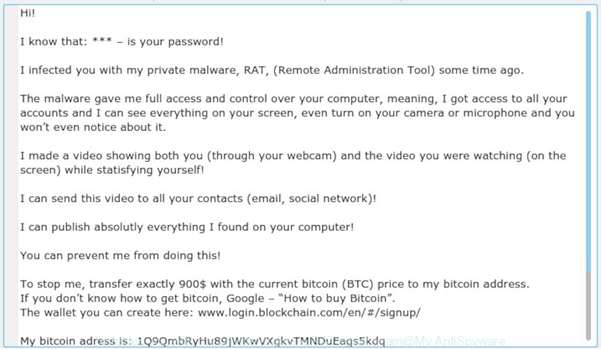
Now a few things about this email:

  1. It was so obvious to me that this email was total crap. Recorded me? Through my webcam? Don’t think so hun cause I’ve got a sticky note over my laptop camera 24/7 because the government are probably spying on me and I don’t need them recording my mental breakdown while watching The Notebook at 2am.
  2. The only thing you’re going to find on my computer are my Uni assignments and I’m sure my essays about English won’t be worth leaking to the 3 email contacts I have on outlook.com
  3. Bitcoin? Come onnnnnnnn – if you’re going to try and get money from someone at least just drop an account number and a sort code. What person of any age is gonna know how to use bitcoin. Read the room babe.

I knew all of this was totally fake and had no truth or legitimate basis behind it. One thing did scare me though. Some weirdo knew the password to my email. I don’t know about you, but my password is pretty long, random and you definitely wouldn’t gain access by typing in something generic like pugs1234. So how the hell did they know this information???

After some research on the web I found out my data had been sold on the DARK WEB!!!!!!!!!!!!!!

The Wire Reaction GIF - Find & Share on GIPHY

As it turns out, Under Armour suffered an attack from hackers who stole personal data from around 150 million users on MyFitnessPal. In short I was one of those 150 million. Sadly, I don’t think this will be my claim to fame </3

Suddenly it all became clear and explained why the bitcoin beggar knew my obscure password. The type of email that I recieved was a type of ‘phising’ scam and they’re surprisingly common. The scammers try to trick you into thinking your device has been hacked and has some weird spyware infecting your device. They then demand payment as some kind of blackmail so that they won’t leak “videos” of you. They even went to the trouble of matching up my password and email that was floating around on the dark web to seem more credible. Jheez, someone is going above and beyond for my attention (and my money). Well, whatever geeza sent me this email is a master in the art of social engineering. They’re also a looser, cause guess what? You don’t have any videos of me, you don’t have any bitcoin and now my outlook has a new password. *smirks*

Better luck next time! This is the phising police and I’m not about to fall for your scam. Get a job if you want money. I know supermarkets are always hiring.

Sassy Black And White GIF - Find & Share on GIPHY

Feel free to comment and let me know if you have experienced any phising scams!!

Quarantine: Scream Time Reports

As the UK implements a lockdown during this whole Coronavirus pandemic, people are finding that they have a lot (and I mean A LOT) of spare time. If you haven’t baked banana bread 3 times this week or turned into a personal trainer then congratulations to you. It wouldn’t be unusual for me to assume that the majority of people have turned to our phones as a source of entertainment to fill our now seemingly empty days. Twitter, Snapchat, Instagram, Tiktok, Facebook are all just so addictive and I can’t help but find myself glued on them for hours at a time. It is easy to tell myself that I will have a ‘quick’ glance on Tiktok and before you know it the sun has set and the stars are starting to twinkle. Oh dear, clearly my self-control ceases to exist.

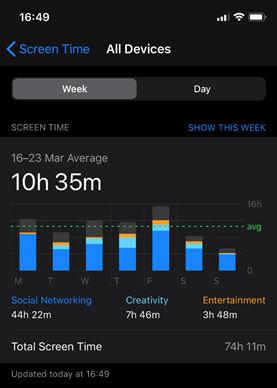
I know that I have been spending way more of my time sucked into my phone, but I was slightly traumatised when I realised exactly how much it really was. No wonder I haven’t learned a new language yet or read an entire book. If you didn’t know, iPhone has a built in feature that sends you a weekly Screen Time report. This features enables you to see how much time you spend on your phone (daily and weekly), the times you are most active and which apps you use the most. It even tells you how many times you pick your phone up. Technology is so crazy.

Now what I am about to share with you guys is slightly embarrassing, but nonetheless I am compelled to let you in on this. During the first week of isolation… I spent an embarrassing total of 74 hours and 11 minutes on my phone that week. I wish I was lying :/

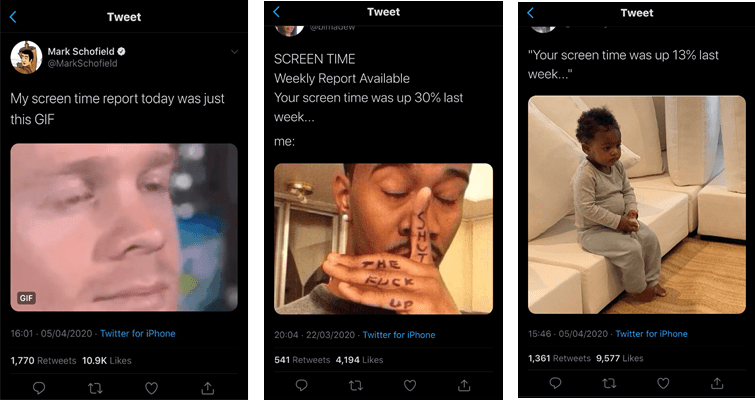
Oh god I need help. Or I need someone to check me into a digital detox rehab centre. Addiction aside, I found that many people were using their phone way more since being in lock down and it made me feel the slightest bit less guilty. Since I was spending 44 hours a week on social media, I clearly had time to find relatable memes about me this on twitter. And let me tell you, it was light work.

Before I delve in to the memes on twitter that soothed my guilt, let me tell you about the type of memes I was LOLing at. Now these memes are images, animated gifs or even short videos that are meant to portray a specific emotion in response to something. AKA reaction memes. This type of meme has become so popular on social media and I always somehow find myself relating to a picture of SpongeBob (I admit that sounds strange).  I guess reaction memes can thank virality for their prevalent existence on social media. It has never been easier for memes to go viral and I think a lot of that has to do with a memes ‘generalisability’ if you like. You can take a picture showing a reaction of someone like Kim Kardashian and come up with a caption for a million different scenarios (obvs not a million I just like to exaggerate). I think another appealing factor is that literally ANYONE can make them. I reckon my Dad could even do it if he read ‘twitter for dummies’ and got his glasses out.

 Since everyone expect key workers are confined to their houses, it’s easy for people to share their feelings online surrounding the pandemic. It wasn’t hard to see that the underlying tone on twitter was ‘OMG I CAN’T BELIEVE THIS IS MY LIFE NOW AND MY SCREEN TIME HAS INCREASED FROM NORMAL WHAT DO I DO??????????’ Here are some reaction memes about Screen Time and phone usage. You’ll probably be able to relate unless you have insane self-discipline.

If trying to view this on a laptop or computer, press the “4,564 people are talking about this” to view the video. Twitter guidelines and that ✌ 

I know I am not alone in waiting for the dreaded Apple Screen Time report every week and I definitely feel a sense of relief in knowing I am not the only one consumed by social media. Luckily, I came to the realisation that 74 hours on my phone was a bit too extreme and since my epiphany, I have managed to cut my screen time down to 43 hours!!! Woooo go me! I figured that it’s unrealistic to turn into a productivity queen, but I also figured that less time off of my phone won’t kill me.

Feel free to comment or share your screen time reports (if you aren’t too embarrassed).

Expectation vs RealiTEA

Black Mirror. Pleaseeeeeee tell me you have seen at least one episode from this science fiction series on Netflix?! It examines modern society and the unanticipated consequences of new technologies. Super interesting and whatever way you think each story is headed, I know for a fact it’ll do a 360 and run in the opposite direction. Now, it may seem as though I’m tryna boost the ratings on this series; but I actually have an interesting connection to make – just trust me and keep reading.

Imagine your daily life. Are you glued to your phone, iPad or laptop? Do you use it to get directions or to research the restaurant with the cheapest delivery fee on Deliveroo? *looks away and pretends I don’t do that*. I bet you take snapchats of things you find funny and spur-of-the-moment shots of quick coffee dates that later end up on the gram. Does 50 likes make you feel good or bad? Does a comment on an Instagram picture make you feel like others enjoy and support your content? What do people think of your online profile where things always seem perfect? Are things actually perfect? The questions could go on and on.  Black Mirrors ‘Nosedive’ (series 3, episode 1 if you want to check it out) perfectly depicts the link between how we value ourselves against the view of others through ratings. Let’s continue…

Nosedive is such an interesting concept, mainly because it’s basically a representation of modern life. It is set in a world where people can rate each other from one to five stars for every interaction they have and these ratings can impact their socioeconomic status. Below is a YouTube clip that provides a quick insight into the episode, from creator and writer Charlie Brooker.

I guess the link between all of this is that even today, people’s online identity is comprised of a social media profile that can be viewed by anyone and you value yourself based off of the interactions of others. I feel strongly that Instagram is an example of this, with influencers trying to gain the approval of their followers though likes or by trying to ‘influence’ them into purchasing a certain product or brand. I guess this stems from social media being about your best self rather than your authentic self. This is similar to main character ‘Lacie’ in Nosedive and her display of a persona designed to be liked by others, even if it isn’t genuine to who she is.

In terms of social media, I think it’s fair to say that if I saw a girl promoting some detox tea whilst  dolled up to the nines, happy asf and in good shape, that I would probably click ‘add to cart’. The problem is that you’re not just buying into a product. You’re buying into the whole concept of allowing others to decide your worth and vice versa based upon the positive or negative reception to content. The desire to feel of worth to others comes down to a need to belong. This sense of belonging is effectively tribalism and denotes our behaviours and attitudes to a certain social group. I think it is important to see Instagram as a particular and somewhat ‘modern tribe’. In this ‘modern tribe’ we feel as though we belong, even if our virtual sense of self is distorted by the response of other tribespeople.

Strange Brew: Reality Stars Are The Active Ingredient For Flat ...

The main message I’m trying to get at is that we all want to belong, but maybe we should all cultivate a little awareness to the fact that everything isn’t as it seems. Lacie couldn’t be bother to maintain her high rating (it’s so hard not to give spoilers) and I think we need to give ourselves a day off now and again. It’s okay if we don’t have our shit together while posting a picture where the shit is together. So the next time you see someone promoting a weird flavour detox tea, maybe consider the usual builder brew. #buildertribe

Let me know if you have seen Black Mirror (or Nosedive for that matter) and feel free to share your ideas below x

Black Mirror's 'Nosedive' episode may have predicted the future in ...
Me on insta vs Me in reality

Mitochondria is the powerhouse of the cell(phone)

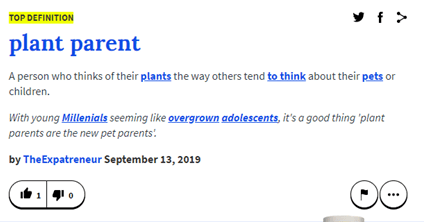
Bonsai Trees. Aloe Vera. Mini Cacti. Peace Lilies. HAPPINESS. Let’s face it: plants are amazing and I have no shame in admitting I am an avid plant parent (and yes it’s a thing).

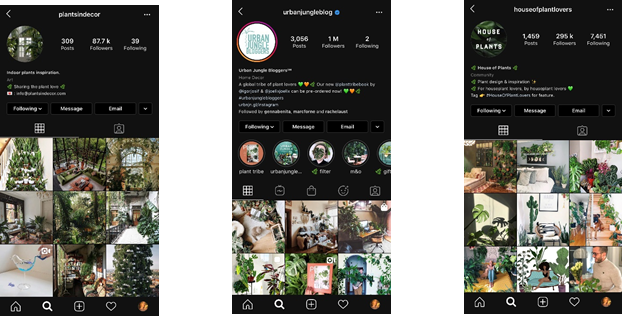
I am not the only one who holds this proud parent title. Dubbed ‘Plantfluencers’, an increasing amount of millennials are leading the way in the plant parent community. Urban Jungle Blog is a community about all things house plants. With a million followers it is clear to see that it isn’t just me who is obsessed with leafy shrubs and adorable succulents.  My Instagram feed is abundant with accounts just like Urban Jungle Blog, posting content designed to light up the hearts of the botanically inclined.

In a world where we are bombarded by stimuli, we humans have the urge to seek information in the easiest and most efficient way. With the human brain processing images 60,000 times faster than text, it’s no surprise that they say a picture speaks a thousand words. Photographs therefore play an important role in everyone’s life. Pictures connect us to our past, remind us of people, places and stories.

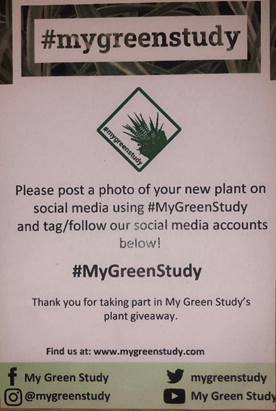
Obviously I am obsessed with plants. It’s a given. Being able to process images faster than text probably explains why I noticed the three mini cactuses on the window shelf in the English work room first. Next to these precious plants was a leaflet entitled “#mygreenstudy’ urging students to post and share photos of their new plants on social media.

By uploading photographs online to platforms such as Instagram, it creates a timeline of our lives by sharing the things, people and memories that we love and want others to share with us. It creates a type of social bonding and can increase solidarity between people. Even the #mygreenstudy tag has enabled a community of plant lovers to come together and participate within that community. It blows my mind that a simple picture and a hashtag can connect you to people with the same interest while grouping similar content. #love (which has 1.221B tags on insta btw).

I guess Houseplants can thank social media for their resurgence in popularity. The financial times published an article stating that the UK’s flower and indoor plant market is worth £2.2 billion and that out of the 6 million people who had taken up gardening; 5 million were millennials. It appears that pictures have a huge power which is deeper and more important than what we often care to realise. Posting pictures of plants has enabled a new haven for existing foliage fanatics while encouraging a new generation to hop onto this growing trend (pun unintended).

I’m certain most of you have tried or became obsessed with avocado thanks to pictures on Instagram of #avocadotoast. Maybe now you can try having custody of a cacti thanks to #plantspiration #plantparenthood #plantpower

Feel free to share your #ideas 🙂

“It’s Gif not Gif” noooo it’s “Gif not Gif”

2 consonants, 1 vowel, and a lot of people left baffled. I opened up google and decided to dig up some information on this whole Gif business. Least to say I ended up confused.com, and by that – I don’t mean the website. Every article, web-page and YouTube video all swayed towards a different pronunciation of this word. With google proving useless *gasps* I decided to throw this conundrum to my twitter followers to discover the most commonly used version of this term. Gif or Jif?

In 24 hours, 88% of people who participated in the poll voted that they use Gif over Jif. Interesting. I suppose that in the grand scheme of things it’s not the way you say it, but rather its use that is detrimental. The same way people pronounce scone to rhyme with cone and scone to rhyme with gone. Either way, you’ll still receive this delicious delight on a late Saturday afternoon, accompanied with a good old pot of English tea. (Scones you have my heart).

Gifs (aside from the controversy surrounding its name) form a very important function in online language and social interactions. Gif is an acronym for ‘Graphics Interchange Format’ and was invented in 1987 – predating the World Wide Web by two years. Its creation solved the issue of displaying still images while saving memory space on a computer. In fact, the first colour picture online was a Gif! Gifs that you and I use today are descendants from 1987 – but with the help of a new fancy algorithm; these still images loop to become animated.

Image result for wow meme gif

Not going to lie to you, but I think Gifs are one of the best inventions since sliced bread. Online interaction has filtered out real time responses that would occur in everyday conversations. Aside from our spoken word, humans understand and are understood by displaying emotion through body language, facial expressions and hand gestures. Emoji’s (bless them) have tried to do their part in fixing this problem, but 90% of the time when I send a crying laughing face emoji; I’m sat with a resting bitch face. Gifs offer an alternative and faster form of communication that perfectly depicts exact feelings and reactions and they can be understood universally.

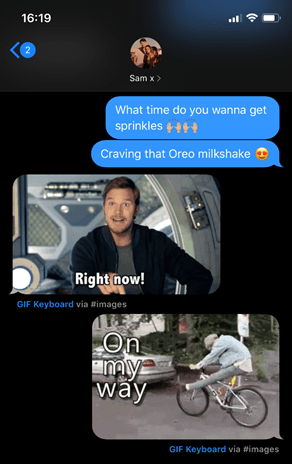
Below is a conversation between me and my boyfriend. I used emoji’s, but they only fulfil their roles to a certain extent. They’re kinda just updated old school smiley faces :/  – but gifs are real people doing real things with real expressions. Sam would never have been able to say ‘right now’ in an emoji – unless it was a clock and then I would’ve been confused. After all, there are 24hrs in a day and I’m tryna go Sprinkles Gelato ASAP.


 Gifs are at the top of their game in enabling expressions where that aspect use to be non-existent online. They’re so prevalent in online interaction that apple has a built in Gif keyboard. They have seeped their way into just about every social media timeline that there is.  They enable fast, fascinating and funny ways of communicating.

They’ve been around longer than the web so I have no doubt that Gifs will remain an elite feature of online communication. After all, the tea would suggest that actions speak louder than words.

Image result for sassy gif

Feel free to contribute to this discussion or even share your favourite Gif below!!!!

Image result for down below gif

Storm Dennis the Menace *NOT CLICKBAIT*

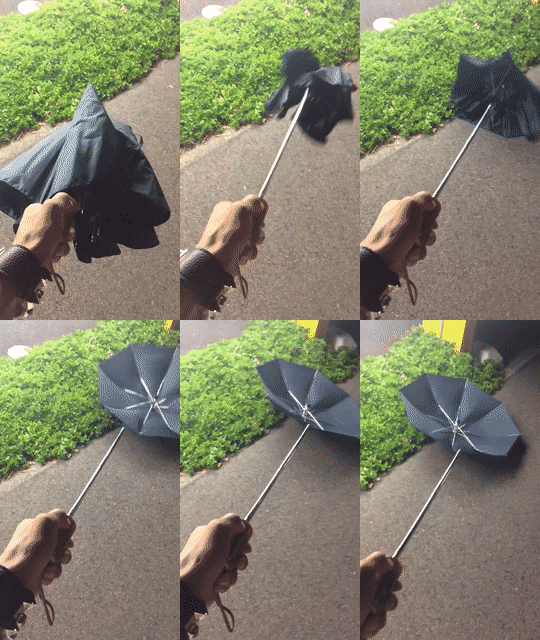
Storm Dennis. Two words, yet when googled it produces 414, 000, 000 results. Following Storm Ciara (which murdered my umbrella and left me drenched), Storm Dennis was also destined to batter Britain with his ferocious winds and heavy rain. He even provoked the Met Office to issue a National Severe Weather Warning. Seems serious and concerning hmm?

This led me to delve into some of these 414, 000, 000 results to find out if Dennis was a storm to be taken seriously, or if it was just a bit of rain blown out of proportion by news platforms, to create scaremongering. You know the type of thing I mean… The news says there is going to be a blizzard, all for it to be a millimetre of sleet. That type of thing.

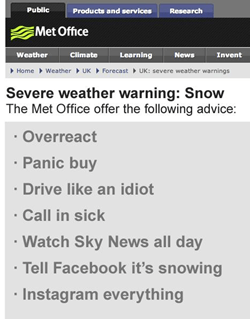
This is a parody created of the Met Office website and their ‘advice’ of what to do when the UK is greeted with snow. The humorous list highlights the exaggerated behaviours carried out by the public when there is a weather warning issued. It clearly demonstrates a serious over reaction on both parts if you ask me. It also shows why most weather warnings are not taken seriously because they’re usually so OTT.

Being able to read online allows people to readily access information, wherever they are and whenever they want. No matter what part of the UK that you live in, a quick google search will tell you how storm Dennis will affect you. A google search highlighted lots relevant news and updates, but I also came across news articles that had clickbait titles (and of course I fell for it) *YAWNS*

Clickbait is a form of false advertisement which uses a hyperlink text that is designed to entice users into viewing a particular piece of online content. More often than not, this information is deceptive and misleading.

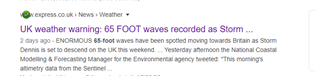
This news article published by the Daily Express, originally led me to interpret that 65 foot waves were recorded on English coasts. At first glance, the clickbait title intrigued me and seemed to point towards the severity of Dennis. The ability to ascertain as much information online as I like, allowed me to discover that 65 foot is roughly the equivalent length of a cricket pitch! THAT’S HUGE!!!!!!

I clicked on the article (thanks to the clickbait title) and I was met with disappointment. I found that this vertical, sea salt cricket pitch, was actually recorded by a satellite in the North Atlantic Sea, and not in Cornwall or Devon as I had imaged. Eugh.

It made me wonder about the progression of reading and writing online. Sure we have come a long way since Gutenberg invented the printing press and even before that. We no longer require ancient scrolls and feather quill pens doused in ink. No. We are much more advanced now. The internet has become a medium whereby it is not just a tool to read from, but also a tool to write on. Having the ability to write whatever you want online for the purpose of entertaining and informing others is somewhat special.

In that sense clickbait just feels… kinda… old? In a world where you can create what you want the tap of a keyboard and with the click of a mouse, I just want the news to spit straight facts to me about storm Dennis. I just want to know what coat is practical and to not get bombarded with the maths of a giant wave. Clickbait appears to have become a transparent use of language, providing attention grabbing stories whilst gaining no traction. Next time I’ll be sure to check out BBC weather. Hopefully that’ll help me decide between a faux fur and a waterproof mac.

Comment below if you have experienced any clickbait articles about storm Dennis or current news in general!!

POV:

Power of storm Dennis

Vs

Primark Umbrella

How Algorithms Rule Your World

Monday. 9am.

Is that my alarm that’s just gone off? Gross. I roll over to turn it off and straight away my beloved phone is back in my hand after 8 hours of sleep sadly put distance between us.  I instantly check my notifications on the home screen (some habits can’t be broken… oops) and it’s all information relating to ME. It’s like a world of material designed to fit my life – the Snapchat notifications from my friends, the YouTube suggestions from the latest channels that I am subscribed to and even the weather for in my location for the day ahead.  Every time I tap the screen, personalised information appears. I’m sure you can relate to your phone producing information unique to you and that I’m not stuck in some digital dystopia where my every move is tracked.  How can a phone possibly know such aspects of our everyday lives and generate such customised and personal content? Should we be worried?

Wednesday. 2pm.

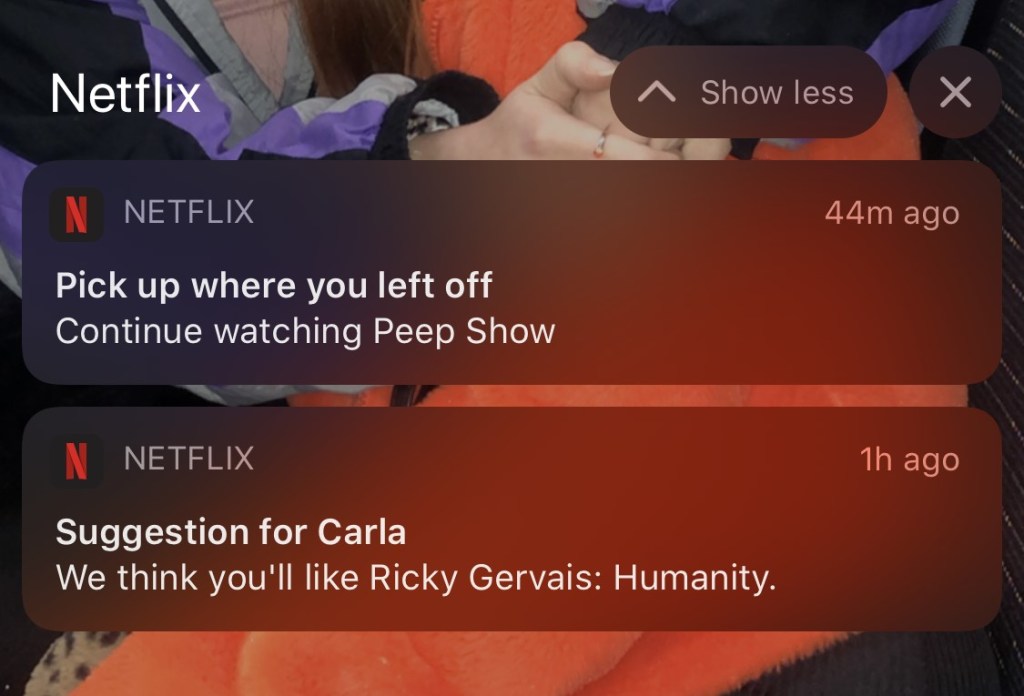
 ‘Continue watching Peep Show’. I AM TRYING TO DO UNI WORK. ‘Suggestion for Carla’ ahhha stop! It’s almost as if Netflix wants me to procrastinate and fail. How can this be?

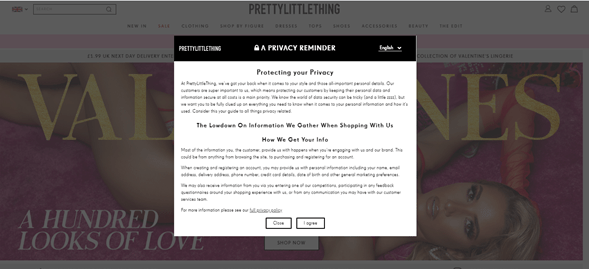
The digital word that is readily available at our finger tips makes use of algorithms. Now, unless you’re into maths or computer science then algorithms may sound like a totally different language. However, algorithms use mathematical rules to study how a set of data behaves. Google and other platforms are highly powerful tools that allow us to locate whatever information we desire. But they also locate whatever information about us that they desire. Algorithms in the digital world are essentially computer codes that use information about us to determine what we like and it then makes recommendations (just like Netflix did for me). These recommendations are usually based off of our internet searches and through cookies which also collect data about you. I’m sure you can relate to clicking on a website where cookies appear. I think we can collectively agree that we all just press ‘I agree’ so it disappears and you can continue browsing (I know I do).

Exhibit A: Cookies interrupting my online shopping addiction.

Algorithms and cookies make way for an interesting discussion point. Technology is so advance that whatever we do is recorded and reported. Is it clever that technology has reached a point where Netflix knows that I need to carry on watching a certain show; or that Spotify thinks I should listen to M.O.M Radio just because I listened to that song by Spillage Village? Or are algorithms and cookies distorting our world view? Do they allow us to live in a world where the information we long for is shaped by what the internet thinks we want to know, rather than what we actually should know?

Perhaps it is time to realise that the internet nowadays isn’t a lens of online information, but rather a mirror of our own information.

Feel free to post any comments and discuss your ideas or these ideas further 🙂

Multilingualism and Memes

“More than 80% of the content on the internet is English” – Fisherman (1998)

This quote alone highlights that there is a clear dominance of English as the language on the internet. I am sure that in some point of your internet usage you have come across a website or social media application that is originally in English, with the availability of it in another language cast aside as a backup. Why is it that English is dominating the internet? Is it this still the case in the modern world of technology?

Since English is considered a ‘universal language’, it will not come as a surprise that English is the language often chosen by individuals of different nationalities, as the primary form of communication. As an American invention, the internet was originally a monolingual tool with its linguistic roots deep in English. But it seems the spread of the internet in recent times is consuming the world and consuming English. Through globalisation, the internet is now a universal medium that connects individuals across cities and seas. The internet is no longer a monolingual tool, but rather a multilingual community where cultures can unite and identities can flourish.

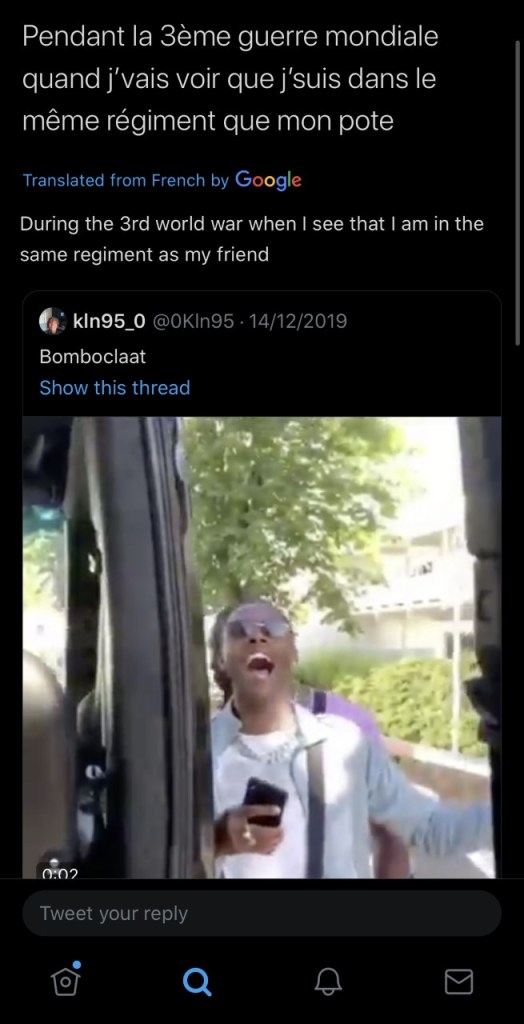
I can relate to the richness of other languages making a name for themselves online. In my first year of university, I lived in accommodation with a student who was part of the Erasmus scheme and who was French. I found it interesting that they would speak to everyone in English (guess that’s due to being in England duh) but would always converse online in French. I follow them on twitter (which is like the elite social media app) and often see their tweets or retweets… but guess what? They’re in French!!!!

Monolingual old me has no idea what any of the tweets say, but with the help of the ‘translate tweet’ button – the French becomes English. Clearly digital media can offer new opportunities for multilingual interaction and can enable even people like me who speak one language to still interact with people who speak other languages.

The internet is a vast online world where information can be found in an array of languages and communications across continents can be held. But for me? At least now I understand memes in French – and for that, I have to thank the multilingual internet for its inclusivity.

Comment below if you found yourself laughing at any multilingual memes recently!!

Design a site like this with WordPress.com
Get started